
How to Delegate to Managers Without Losing Control of Your Business

If you run a 5–50 person business, you already know the trap: you hired managers, yet you still answer the "quick questions," approve the small stuff, and jump into customer issues. It feels like control. It also keeps the business dependent on you.
This guide shows you how to delegate to managers without losing control of your business — a clean way to hand off day-to-day ownership while you keep standards, visibility, and the ability to course-correct fast.
Step 1: Redefine "control" so you can actually delegate
Most owners step in to prevent mistakes. Over time, the team learns a quiet lesson: wait for the owner. That is how "helpful" turns into a bottleneck, even when you have managers. TAB makes a similar point: delegation works best as a repeatable process, not a one-off handoff.
Working definition
Control = clear outcomes, reliable visibility, and fast course correction.
Your ops manager can solve a late-job issue, but you jump in "just this once." Next time, they bring it to you sooner.
A common owner scenario — and how a single intervention resets a manager's behavior
Concrete takeaway (10 minutes)
Write your one-sentence definition of control.
List three weekly signals that create control for you: one number, one customer signal, one people signal.
Step 2: List everything you touch in a normal week, then sort it by value
Most owners guess where their time goes, then delegate based on guilt. A quick inventory changes that. TAB recommends writing down everything you did this week as a first move toward smarter delegation.
A 5-day log
Set a timer for 30 minutes today. Dump every task you touched this week.
For the next five business days, jot tasks in real time.
Sort each task into one bucket: growth, risk, people leadership, customer delivery, admin.
Highlight the top 10% that only you can do.
Common traps to watch for
Recurring approvals (pricing, refunds, hiring, discounts)
"Quick" fixes that steal hours
Customer escalations that bypass managers
You log 42 tasks. Only 4 are owner-only: bank relationship, key customer renewal, culture and standards, strategic partnerships. Everything else becomes a delegation plan.
Mini example of what a task audit typically reveals
Step 3: Decide what you will never delegate — and what you must
Draw a bright line between owner calls and manager calls. Delegation works best with clear boundaries, not a vibe-based handoff.
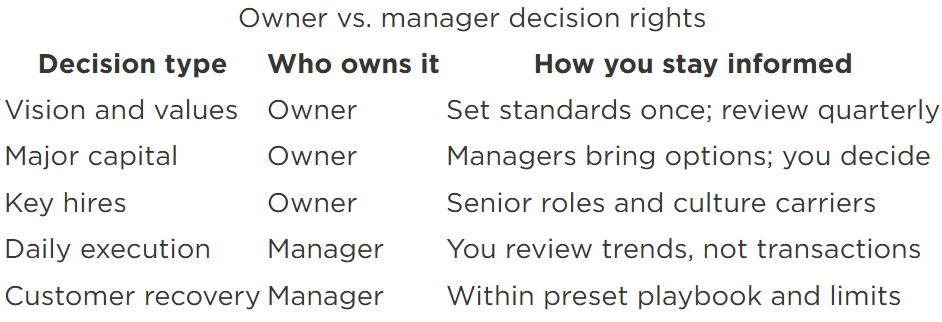
Decision thresholds
Dollar limit
Example: manager approves purchases up to $500.
Risk flag
Safety, legal, and compliance issues always escalate.
Brand trigger
Public commitments and pricing exceptions always escalate.
Concrete takeaway
Draft a one-page Owner Guardrails list: five owner-only calls and five manager-owned calls, each with a dollar limit.
Step 4: Pick the right managers for delegation, not just the most loyal
Loyalty feels safe. Tenure feels earned. Neither guarantees leadership capacity. You need managers who can carry outcomes when you are not in the room.
A long-tenured "go-to" person may stay in their lane, wait for direction, or avoid hard calls. That is reliability, not leadership. Delegation breaks when you hand over responsibility to someone who only executes tasks.
Three signals to look for
Judgment
They choose a solid option with imperfect information and explain why.
Follow-through
They close loops, hit dates, and clean up loose ends.
Communication cadence
They update you before you ask, with facts and next steps.
If a manager still performs at "C" efficiency six months in, treat it as a real issue. Choose: train, coach, or change the seat.
Quick diagnostic
Score each manager 1–5 on judgment, follow-through, and communication. Pick the manager with the highest total and delegate one outcome to them first.
Step 5: Delegate outcomes, then define standards in plain language
Stop delegating a list of tasks. Delegate a result, then spell out the standards so your manager can run without "quick questions" every hour. This lines up with TAB's view that delegation works best as a repeatable process, not a vague handoff.
Outcome statement format
What + by when + how you will measure it.
"By Friday at 3 pm, reduce open customer tickets from 42 to under 15, with first response time under 2 hours."
Example outcome statement with clear measurement criteria
Standards cover
Quality
"No reopened tickets from missing steps."
Timing
"Daily triage by 10 am."
Customer experience
"Use our apology script when we miss SLA."
Compliance
"Log refunds with reason codes."
One-page delegation brief
Outcome | Standards | Deadline | Budget | Risks | Reporting cadence (example: 15 minutes every Tuesday, dashboard only).
Step 6: Use a levels-of-authority table so managers know when to act
Interruptions usually come from one gap: managers do not know when to act vs. when to pull you in. A one-page authority table fixes that. It supports effective delegation as a repeatable process, not a daily negotiation.
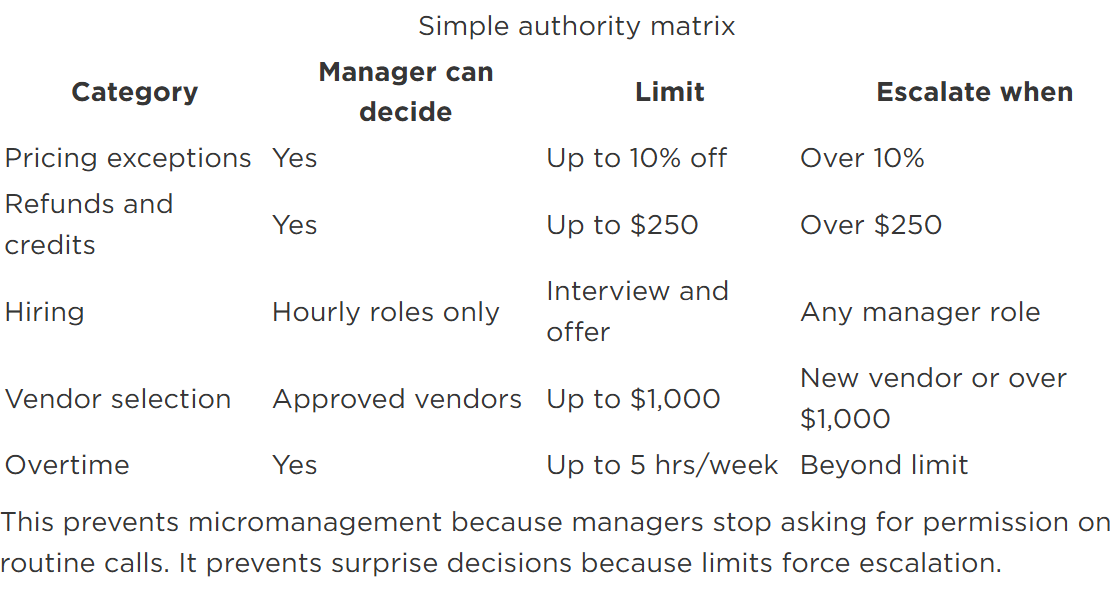
Concrete takeaway
Build this table, then walk through it in a 30-minute meeting with each manager. Clarity drives autonomy.
Step 7: Install a weekly visibility rhythm that replaces constant check-ins
Stop chasing updates and start running a cadence. Delegation works when you trade hovering for a predictable view of the business, week after week. TAB frames this as shifting owner time away from urgent tasks and into higher-value leadership work.
Weekly 1:1 agenda (30–45 minutes)
Require a one-page pre-read by end of day before the meeting with three metrics and three priorities. Run this fixed agenda:
Numbers: what moved and why
Priorities: what is on track, what is stuck
People: wins, gaps, coaching needed
Risks: customer, cash, compliance, safety
Asks: decisions needed from you
Monthly ops review (60–90 minutes)
Scan trends, capacity, customer signals, and process breakdowns.
If a manager shows up unprepared, end early and reschedule within 48 hours. Repeat twice, then treat it as a performance issue, not a meeting issue.
Step 8: Build a simple dashboard that shows you the business without you running it
Stop "checking in" and start checking metrics. A simple weekly dashboard gives you visibility without pulling you back into daily work. Keep it consistent: same day, same format, same definitions. Your dashboard becomes the heartbeat of your delegation process.
Your metric checklist (pick 5–9 total)
Cash on hand (weeks)
New qualified leads
Closed-won revenue
On-time completion rate
Customer complaints or refunds
Open roles or turnover risk
Rework rate or defects
For every metric, define: target, red flag threshold, manager owner, and action trigger.
On-time completion below 92% triggers the ops manager to run a 30-minute root-cause review and post a fix by Friday.
Example metric with owner, threshold, and action trigger defined
Step 9: Document the processes that protect quality and cash flow
Stop trying to document everything. Write down the workflows that, when they break, create rework, refunds, and late invoices. Those issues drain cash and pull you back into the weeds. Delegation works when you spell out expectations, owners, and follow-through, then let managers run the play.
Minimum viable SOP includes only
Purpose (what "good" protects)
Steps (5–10 bullets)
Owner (one name)
Handoffs (who gets what, by when)
Quality checks (2–3 must-pass items)
Start this month with these three
Quoting
Invoicing
Customer escalation
Checklists beat manuals. If it cannot fit on one page, it will not get used.
Step 10: Coach your managers on problem-solving so they stop bringing you fires
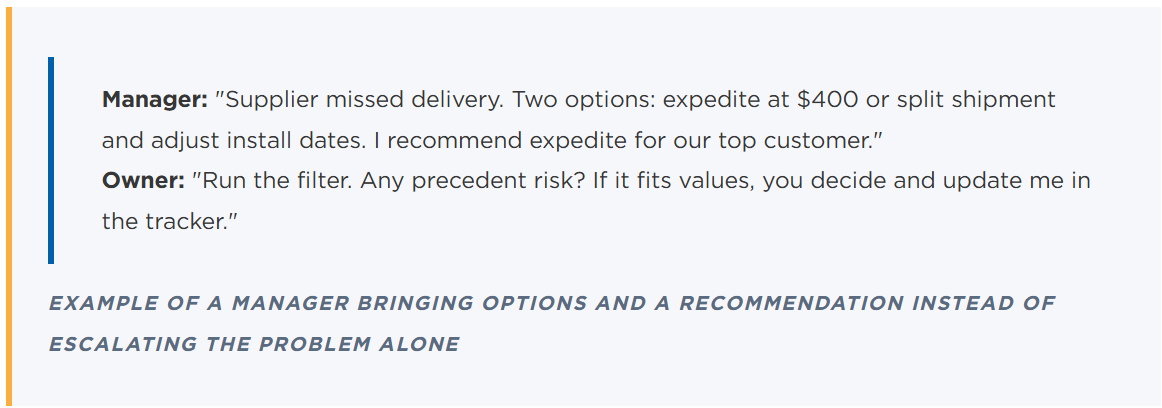
Fires still happen. The change comes when managers bring thinking, not just smoke.
The "No Upward Delegation" rule
New rule: "Bring me the problem with two options and your recommendation." This builds manager confidence over time, even from a slow start. TAB notes that managers who start at "C" efficiency improve consistently through this kind of coaching.
Decision filter managers should run
Customer impact
Who feels this and how fast?
Cost
Dollars, time, team capacity.
Precedent
Will this become "how we do it"?
Values
Does it match our standards?
Step 11: Set accountability that feels fair — scorecards, consequences, and support
Scorecards tie outcomes to expectations so nobody guesses what "good" looks like. Clarity lowers stress on both sides. Predictable accountability is what lets owners delegate with confidence.
When metrics stay red
Week 2 red: Written reset on expectations plus a short action plan.
Week 4 red: Formal performance plan, role change, or exit decision. No surprise rescues.
Before you call it a people problem, remove friction first
Training or process refresh
Mentoring or shadowing
Resource fixes (tools, staffing, authority)
One-page manager scorecard
Three outcomes (monthly)
Revenue, Margin, On-time delivery
Three lead measures (weekly)
Quotes sent, Jobs scheduled, Quality checks
Review date
First Tuesday monthly, 30 minutes
Step 12: Run a 30-day delegation pilot, then lock in what works
Run a low-risk pilot rather than handing everything off at once. TAB frames delegation as a repeatable business process you can improve over time — treat it that way from the start.
Your 30-day pilot plan
Pick one function and one manager (scheduling, purchasing, or customer escalations).
Define one outcome and matching authority in writing: decision rights, budget limit, and when to pull you in.
Set a weekly cadence of 15–30 minutes with one agenda: results, issues, next week's plan.
Track four signals
Interruptions
How often does the manager need you?
Cycle time
How fast does work move?
Quality
Rework, complaints, misses.
Manager confidence
1–10 score each week.
At day 30, decide with specific reasons — keep, adjust, or pull back — then scale to the next area.
Start your pilot next Monday
Pick one delegated outcome, set one reporting rhythm, and schedule your day-30 debrief today.
Frequently Asked Questions About How to Delegate to Managers
How do I delegate to managers without losing control?
Redefine control as clear outcomes, reliable visibility, and fast course correction — not personal involvement in every decision. Build authority tables that define when managers act vs. escalate, install a weekly visibility rhythm through structured 1:1s and dashboards, and run a 30-day pilot on one function before scaling delegation further.
What should a small business owner never delegate?
Owner-only decisions typically include: vision and values (what "good" looks like), major capital commitments, senior and culture-carrier hires, and final accountability for business outcomes. Everything else is a candidate for delegation with appropriate guardrails.
How do you set up managers for delegated authority?
Define a clear outcome (what, by when, how measured), set written standards for quality and compliance, establish a one-page authority table with dollar and risk thresholds, and run a weekly check-in cadence so you maintain visibility without hovering.
What is a levels-of-authority table?
A levels-of-authority table is a one-page reference that defines, by decision category, whether a manager should inform you, recommend options, decide independently within limits, or escalate. It removes the guesswork that causes managers to interrupt owners on routine calls.
How long should a delegation pilot last?
A 30-day pilot is enough to generate useful data. Pick one function, one manager, and one delegated outcome. Track interruptions, cycle time, quality, and manager confidence weekly. At day 30, decide whether to keep, adjust, or pull back — then scale to the next area.
Written by Dave Scarola
Dave, one of our C-Level executives at The Alternative Board, has over 20 years of consulting, product development and technology experience across many different industries including telecommunications, hospitality, healthcare and financial services.